
How AI is transforming Luxembourg's financial sector
AI is reshaping Luxembourg's financial sector. Companies are moving beyond isolated experiments towards full-scale AI industrialisation. Leaders from Luxembourg's insurance and fund industry shared how they are making this transition during SCynergy 2026.
21/04/2026
How is the financial sector unlocking AI's value while navigating a world of regulation and risk?
This was the central question addressed during a recent fireside chat at Scynergy, where leaders from Luxembourg’s insurance and asset management sectors shared first-hand insights on moving AI from potential to performance.
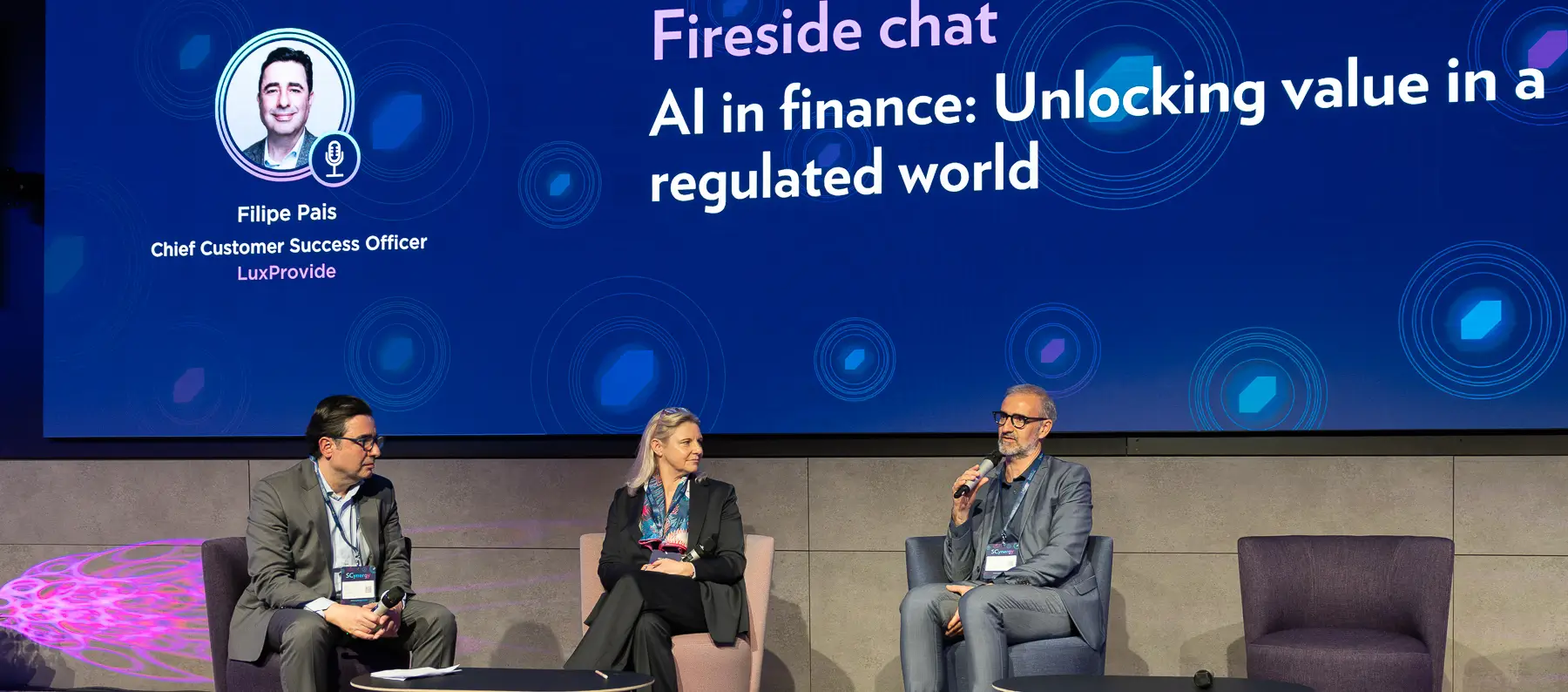
The panel, held at the Chamber of Commerce on 14 April 2026, featured Marie-Hélène Massard, Foyer Group CEO, and Serge Weyland, CEO of the Association of the Luxembourg Fund Industry (ALFI), in a discussion moderated by Filipe Pais, LuxProvide Chief Customer Success Officer. A key theme was the industry's transition from isolated experiments to integrated, large-scale implementation.
AI in insurance: driving growth, not just efficiency
Marie-Hélène Massard captured this shift perfectly, stating, "We went through a lot of experimentation… but we are now able to develop the use cases. The great challenge is really industrialisation."
For an established insurance group like Foyer, the impact is already being felt in core operations. AI is driving efficiency by processing unstructured data from the vast number of documents the industry handles daily. However, Massard emphasised that the benefits extend far beyond cost reduction. She sees AI as a catalyst for growth and talent development. The CEO noted that AI enables them to expand into new markets and complexities "with no new teams," which in turn allows the company to "really focus on our talents and upskill our people."
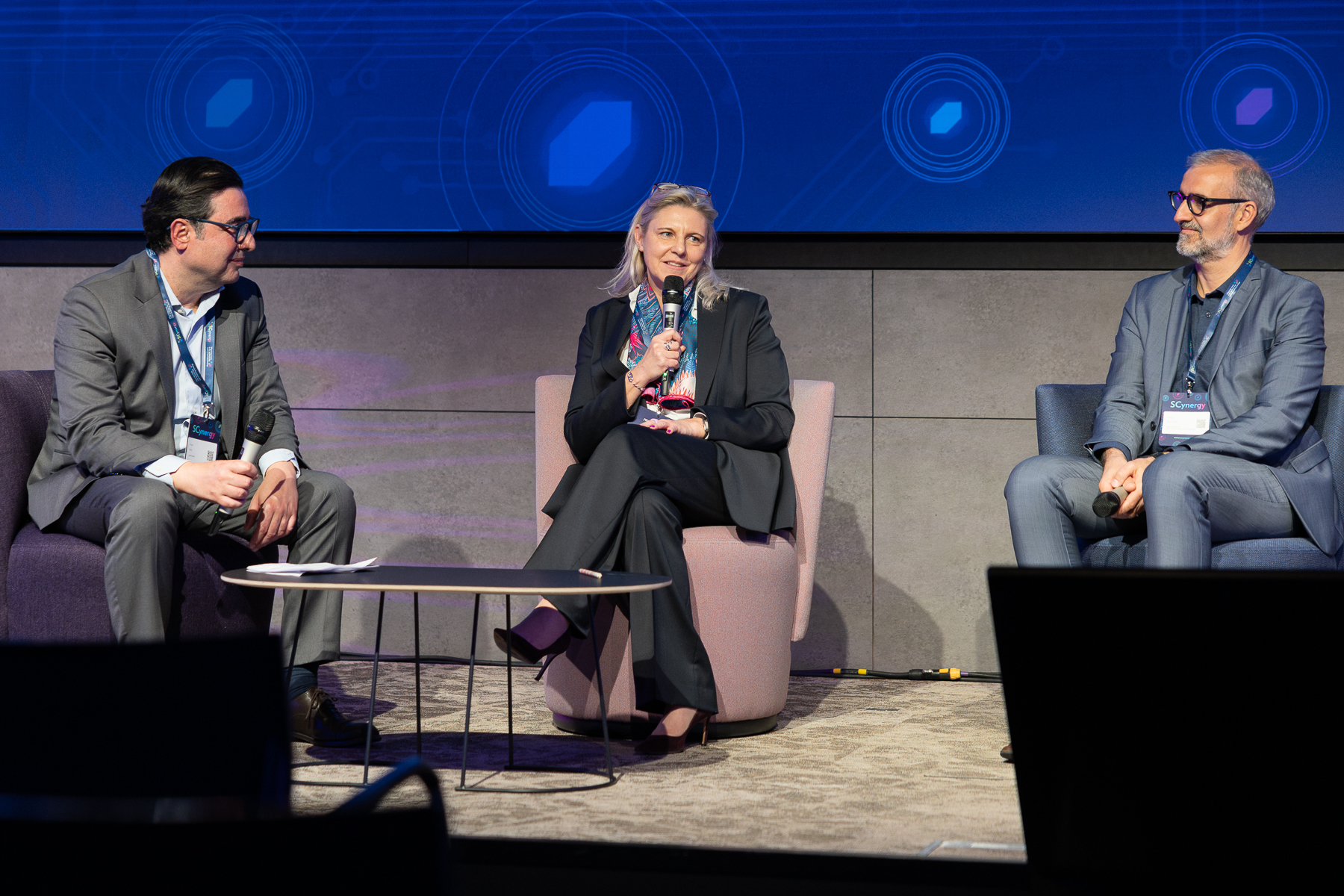 The panel took place at Scynergy on 14 April.
AI in asset management: unifying fragmented data
In the asset management sector, which represents €8.3 trillion in funds in Luxembourg, AI is tackling the immense challenge of data fragmentation. Serge Weyland highlighted how AI helps create a unified view from disparate sources. He explained, "If you are exposed to hundreds or thousands of funds… you need to have an aggregate view of your risk exposure… and that's where AI can help, basically digesting all of those reports that are not standardised." One popular use case in Luxembourg, the CEO added, is managing due diligence questionnaires, where every investor has their own format. AI can automate responses, delivering significant efficiency gains.
While the technology offers powerful solutions, both speakers stressed that its adoption must be human-centric and user-driven. Weyland voiced a key concern: "My first biggest risk is that people do not engage enough with AI." He advocated for empowering employees to innovate from the ground up, stating, "It should be user-driven… it's not technology that you roll out from the head office and then you expect everyone to use it in the same way." He added that in most cases, the result has been "an increase in quality, not a decrease in headcount."
This technological evolution demands a shift in mindset. Massard urged the audience to look beyond the technology itself. "We focus on tech, but we should focus more on the rest: the speed, the agility, and the compliance. We need to redefine the way we take decisions," she advised.
Governance and trust in AI-driven finance
This new decision-making framework must address critical governance issues. As clients and investors begin using AI to screen financial products, new questions arise. Weyland asked, "How do you ensure that the features of your products [are accurately reflected] in those models?" Ensuring accuracy and independence is a challenge the industry must tackle collectively. This is where national initiatives like the Luxembourg AI Factory become essential, providing a trusted framework for companies to develop and validate responsible AI solutions.
Ultimately, the consensus was clear: the best way forward is through hands-on, creative exploration in a secure setting. As Weyland concluded, the key takeaway is to "play around with the technology, get a safe environment for your data, and let users come up with use cases." Creating this "safe environment," as offered by the Luxembourg AI Factory, allows companies to turn creative ideas into economically viable business opportunities.
In her closing remarks, Massard left the audience with a powerful reminder of where the ultimate responsibility lies: "Don’t let AI shape our future, we need to keep the power."
The message from Luxembourg's financial leaders is clear: AI adoption must be ambitious in scope but disciplined in governance. By combining human-centric innovation with trusted infrastructure such as the Luxembourg AI Factory, the sector is positioning itself to lead responsibly in the age of artificial intelligence.