European space AI: Balancing speed and safety in orbit
European space AI is transforming orbital operations. Experts at NeoSpace discuss how to balance speed, computing power and trust in space.
 Emilio Naud
02/11/2026
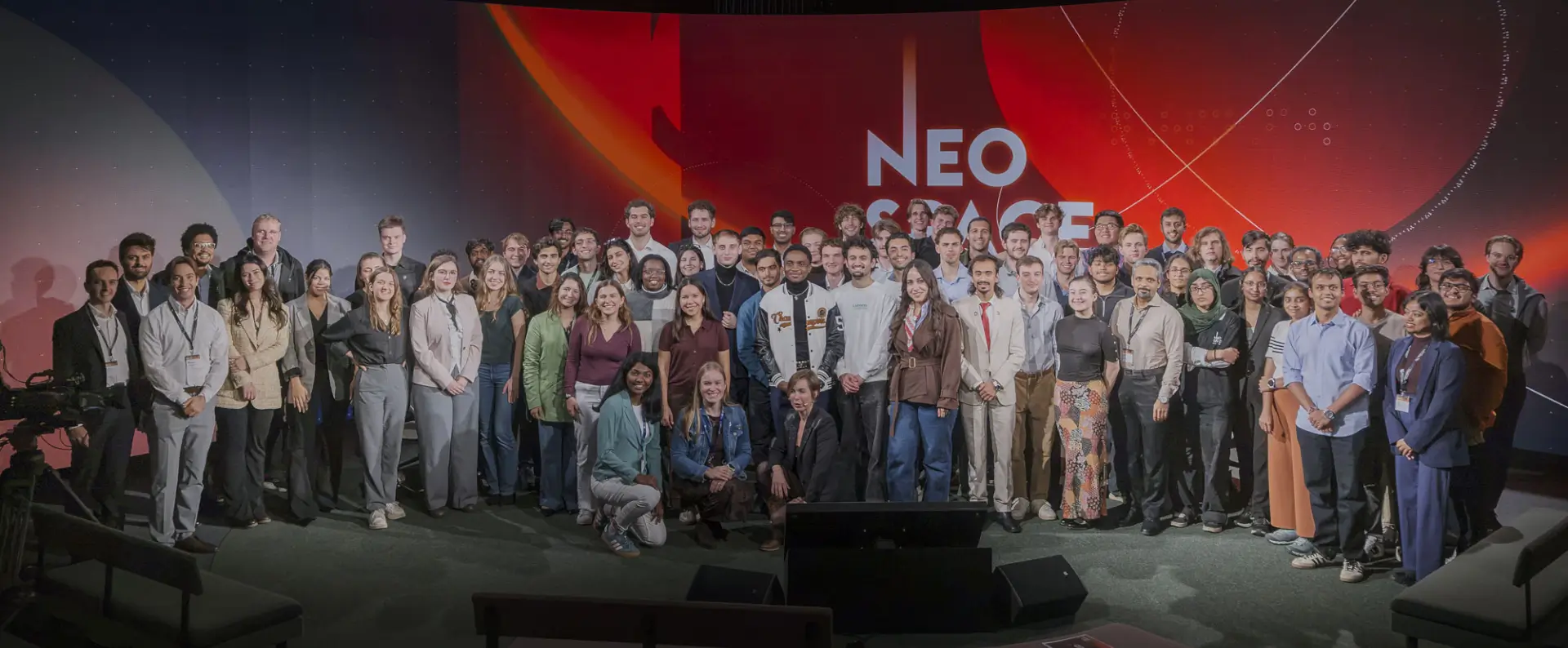
With modern satellites producing up to 85 terabytes of data daily, Luxembourg space AI is transforming orbital operations by moving computation from the ground into orbit. This critical shift was the focus of the panel "The AI Space Race: Where AI Is Transforming Space and Caution is Leading NewTech in space" at the NeoSpace conference, organised by the Luxembourg Space Agency (LSA) on 19 and 20 October 2026. Moderated by Alberto Maulu, Manager Technologies at the LSA, the panel explored how to balance technical speed with operational safety.
Space AI meets the orbital data bottleneck
As the space sector expands, raw data from Earth observation satellites has reached unprecedented levels. Cynthia Marcelino, Co-Founder and CTO of LeoTrek, noted that while older satellites produced up to 1.5 terabytes of data daily, "new satellites produce 85 terabytes of data per day. You just cannot download all those data." To address this, LeoTrek focuses on distributed orchestration across existing satellites. "Our goal is to move the computation that happens today from the cloud to the space itself," Ms Marcelino explained, highlighting that real-time insights are crucial for disaster response.
This edge computing shift requires a fundamental redesign of space hardware. Jaroslaw Jaworski, CEO of Edge Aerospace, stated that "in-space computing is the next bottleneck because it could have so many applications. This is the right problem to solve to hopefully become the next unicorn." Mr Jaworski noted that building computers for space requires making them radiation and heat tolerant to unlock advanced applications like real-time synthetic aperture radar (SAR) -a remote-sensing technology that creates high-resolution images of the Earth's surface using microwave pulses- data analytics.
Trust, safety and regulatory compliance for space AI
Integrating AI into critical space operations introduces significant safety and verification challenges. Livia Manovi, Research Fellow at the European Space Agency, explained that running heavy Earth-based AI models in space is difficult due to radiation effects on memory. Verifying autonomous decisions is also computationally expensive. "The computation that you need to allocate to verify the trustability, the reliability and the quality of that specific decision is sometimes even more demanding than the classification task itself,” Ms Manovi noted.
This complexity makes regulatory alignment and human oversight paramount. Ms Marcelino cautioned that "it is not because you can do something with AI that you should do it," advising against using AI for deterministic tasks like flight services. Mr Jaworski agreed on the importance of human accountability: "Even if AI is seen as a tool, if you created something using this tool, you're still responsible for the output."
To bridge this gap, Andrés Jimenez Gomez, Business Relationship Advisor - Data & AI at Luxinnovation, explained that Luxembourg AI Factory supports space-sector organisations in developing trustworthy solutions. "We already deployed certain sandboxes to check the regulatory compliance with the EU AI Act before models are deployed into production," Mr Jimenez Gomez noted. He also highlighted that data availability remains a key hurdle for larger organisations: "When we approach more corporates, the main roadblock that we see when adopting these AI solutions is actually that the data is not there to leverage solutions internally."
How Luxembourg AI Factory enables trustworthy space AI
As space is one of the four priority sectors of Luxembourg AI Factory, the initiative provides a comprehensive suite of services to help space innovators scale their solutions. For startups and SMEs, Luxembourg AI Factory offers a dedicated entry point to de-risk technology development.
Through the initiative, companies can access AI model design and training for AI-based space applications to build compact, efficient models suitable for low-power satellite platforms. To ensure compliance with the EU AI Act, businesses can leverage the AI Assessment Sandbox to perform independent testing across all dimensions of trustworthy AI. Furthermore, when real payload data is scarce, the Synthetic Data Factory service helps generate high-fidelity datasets.
To discover how your business can benefit from these resources, explore our AI adoption programmes and connect with our expert team.