

58% of European work at risk: why AI reskilling matters now
A McKinsey study finds demand for AI-fluent professionals has surged fivefold in Europe — Luxembourg's AI Factory offers businesses a head start on reskilling.
 Emilio Naud
05/06/2026
The McKinsey Global Institute's latest report, "Agents, robots, and us: How AI reshapes work and skills in Europe", concludes that generative AI will accelerate workplace automation across the continent far faster than previously estimated. The study analyses ten major European economies and sets out how businesses and workers must adapt to human-machine collaboration.
How AI could automate 58% of European work hours
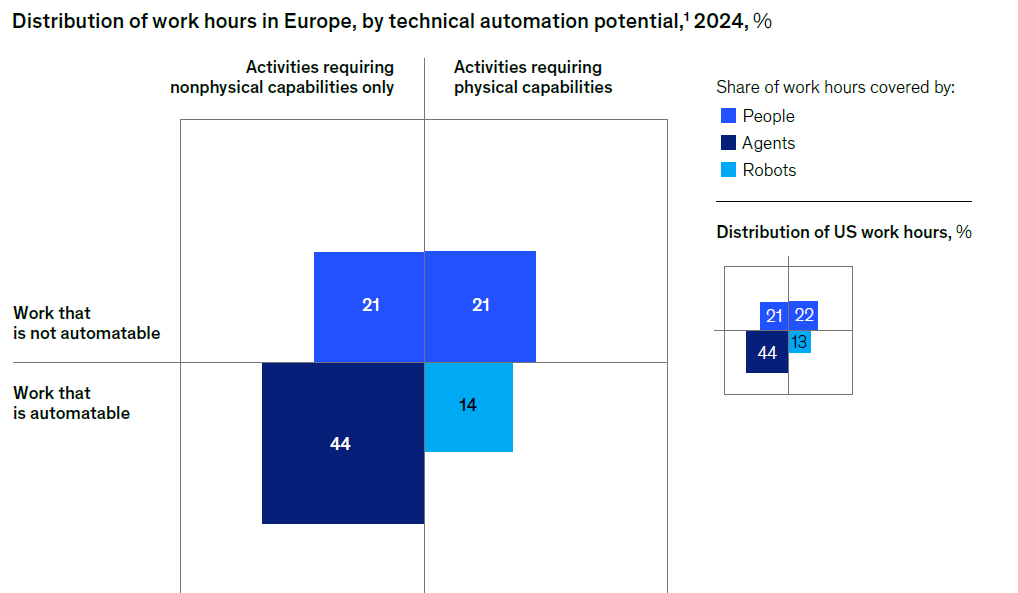
The report's central finding is that 58% of all work hours in Europe could theoretically be automated by existing technologies. This is not a forecast of mass unemployment, but a fundamental reorganisation of work itself. The automation potential is primarily driven by cognitive tasks, which could be handled by AI "agents" (44% of hours), with physical tasks performed by robots accounting for the remaining 14%.
Sectors such as office and administrative support, customer service and sales, and food services are among those facing the highest automation potential, according to the report. As these technologies become integrated, the nature of jobs will evolve, demanding closer collaboration between humans and machines. This transformation could unlock up to $1.9 trillion (approximately €1.7 trillion) in economic value through productivity gains by 2030, but only if companies and workers adapt.
Why AI fluency is the most in-demand skill in Europe
Rather than making human skills obsolete, the report argues that most will be applied differently. A striking 75% of skills currently demanded by employers are considered "shared" — essential for both automatable and non-automatable activities. This suggests a future of partnership, where AI handles routine work while humans focus on higher cognitive functions and socioemotional skills like critical thinking, creativity, advanced communication, leadership and empathy.
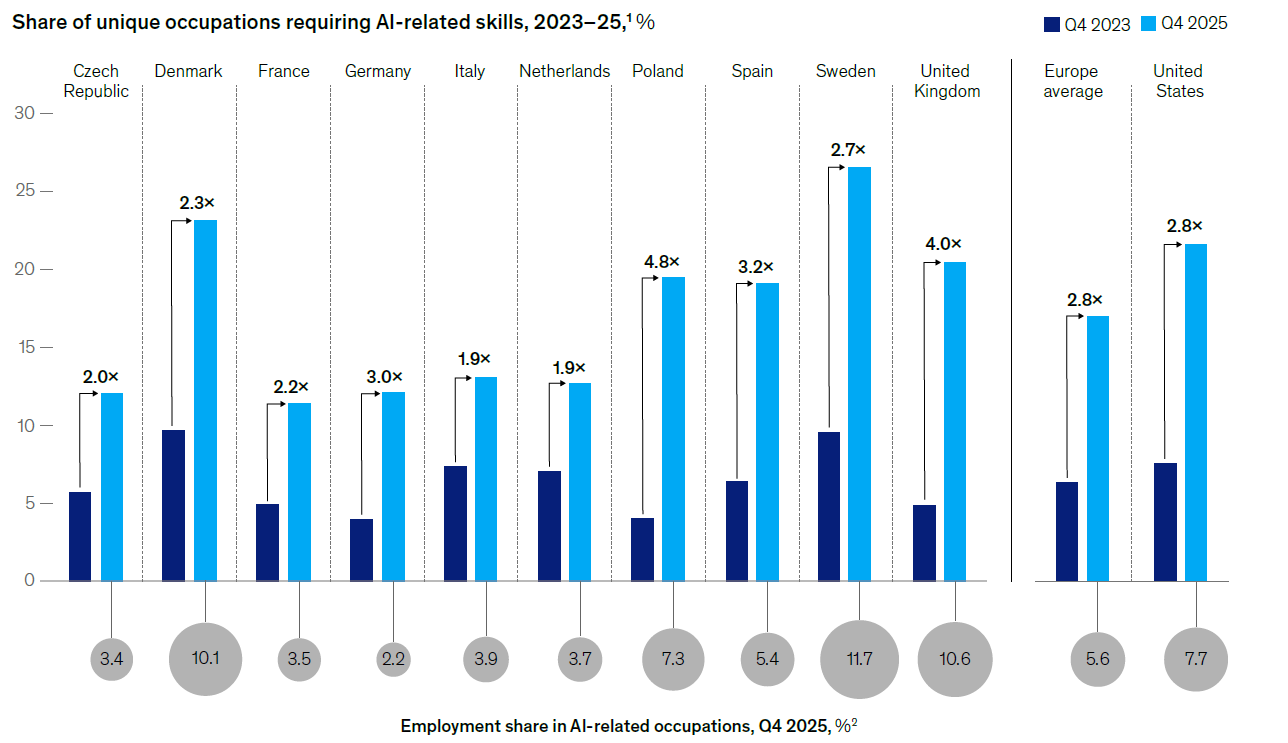
This shift is already reflected in hiring trends. Since 2023, demand for AI fluency — the ability to effectively use, interpret and manage AI tools — has surged fivefold across Europe. The pace, however, varies significantly between nations. Job postings requiring AI skills have rocketed in Poland and the United Kingdom, increased threefold in Germany, and grown more moderately in countries like France, while remaining flat in the Netherlands. This rising demand highlights the urgency for businesses to invest in targeted training and development programmes.
How Luxembourg supports AI reskilling for businesses
Luxembourg businesses can proactively address the report's central challenge — the urgent need for AI-related upskilling — through dedicated national initiatives. The challenge of preparing the workforce to meet the AI revolution is precisely what Luxembourg AI Factory is designed to address. For local SMEs and larger businesses, navigating this transition requires a clear strategy for talent development and technology adoption.
Luxembourg AI Factory offers concrete programmes to help businesses build their AI capabilities. Through tailored AI skills training and dedicated SME support programmes, companies can equip their staff with the AI fluency that is now in high demand across Europe. These initiatives provide a direct benefit, enabling employees to work alongside new AI systems, develop innovative AI-powered products and boost overall competitiveness.
Proactively embracing reskilling will be the defining factor for European businesses aiming to thrive in an economy powered by human-machine collaboration.
Key findings
- 58% of European work hours could theoretically be automated
- AI "agents" account for 44% of automatable hours; robots for 14%
- 75% of skills demanded by employers are relevant to both human and AI-augmented work
- Demand for AI fluency has increased fivefold since 2023
- Productivity gains of up to $1.9 trillion (approximately €1.7 trillion) could be unlocked by 2030