AI needs people: researchers meet industry in Luxembourg
At our first AI Talent Matchmaking Event, early-career researchers from the Greater Region sat down with Eurobank, Deloitte and PwC to explore how their expertise can help solve the AI challenges facing finance and cybersecurity.
 University of Luxembourg
28/10/2026
Artificial intelligence is changing how banks manage risk, how advisory firms serve clients and how organisations defend themselves against cyberthreats. The technology is moving fast. The talents who know how to apply it well are hard to find.
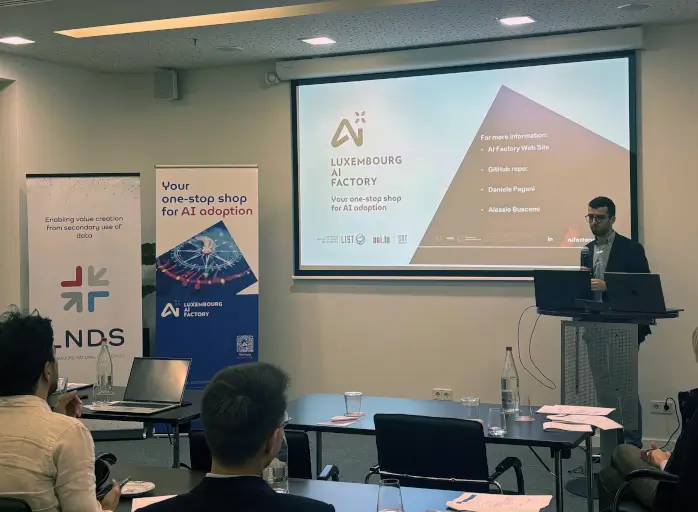
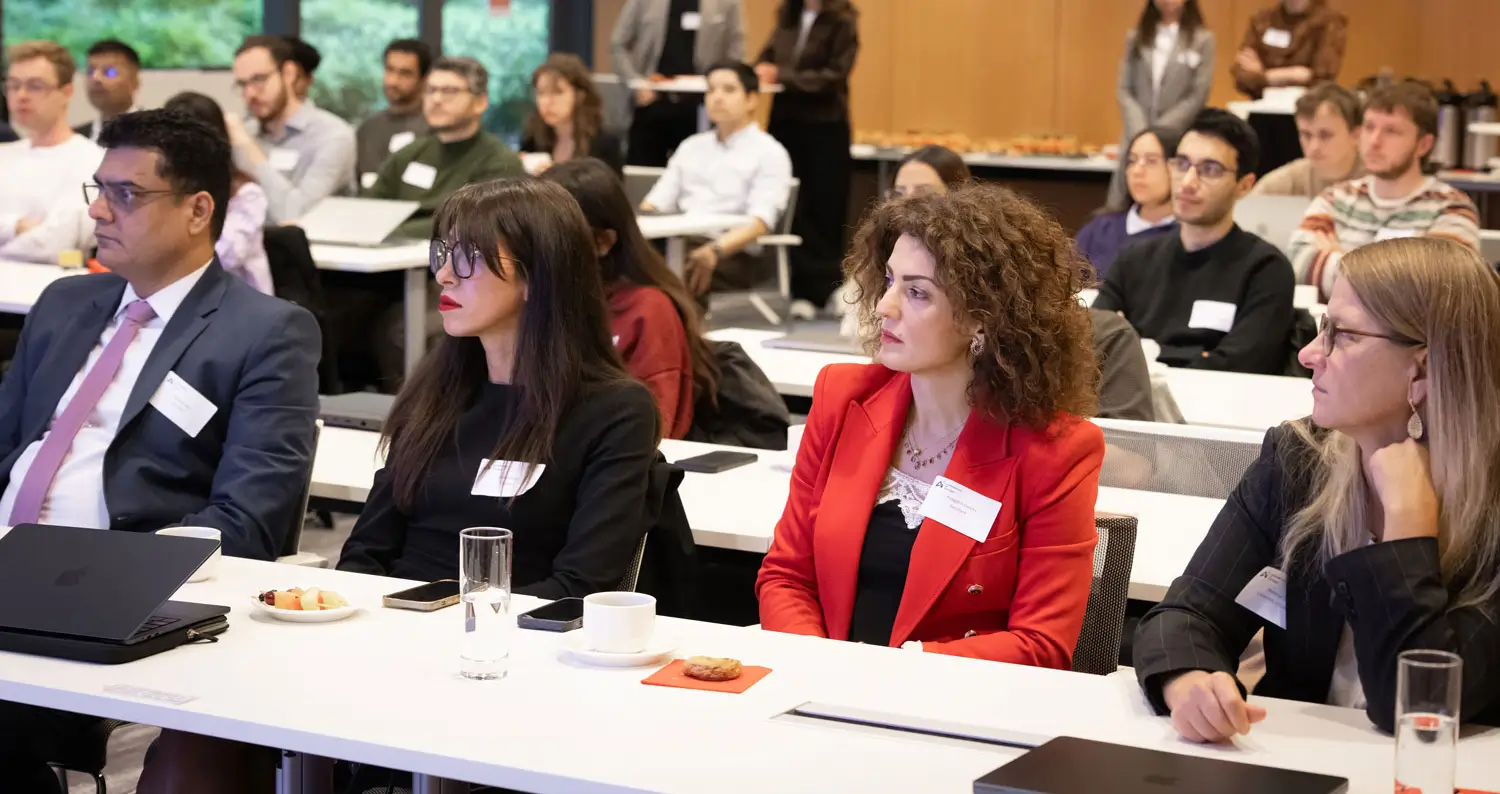
On 9 October 2026, Luxembourg AI Factory and the Luxembourg Chamber of Commerce organised the first AI Talent Matchmaking Event, bringing researchers and businesses into one room to connect academic expertise with real industry challenges. Around 35 doctoral candidates, postdoctoral researchers and recent graduates met representatives of three of Luxembourg's leading financial and professional-services organisations. Through targeted matchmaking, each participant's research interests and expertise were aligned with concrete business challenges identified by the companies, to start conversations that could grow into research collaborations, joint projects and careers.
Why AI talent matters for Luxembourg
"AI does not just depend on infrastructure. It depends on people," said Prof Simone Niclou, Vice-Rector for Research at the University of Luxembourg, as she opened the event. "We need the knowledge in the new generations to be able to use it fruitfully and also responsibly."
Finance and cybersecurity were chosen as the focus for a reason. Both are being reshaped by AI, and both are pillars of Luxembourg's economy. The AI ecosystem reflects this: according to the Luxembourg AI ecosystem mapping, 26% of AI solution providers in the country target IT and cybersecurity, and 18% target finance and insurance. For a small, international economy built on financial services, having AI talent ready for these sectors matters directly to its competitiveness.
For the Chamber of Commerce, the initiative is part of its broader commitment to strengthening connections between research, education and business, while helping companies access the skills and expertise needed to drive innovation and succeed in a rapidly evolving economy.
There is no playbook yet. Help write it
Keynote speaker Flavio Garcea, Head of the AI Delivery Hub at Clearstream, built his talk around the four questions he hears most often from candidates, students and colleagues. His team has existed for two and a half years, "which in AI terms feels like centuries".
Do I need to be technical to work in AI? No, he said, though developers remain essential. In enterprise AI, domain experts no longer hand over requirements and wait. At Clearstream, business and IT now sit together from the first idea, and the people who know the problem test, fail and try again with the tools themselves. Working prototypes now arrive in weeks. "Everybody's expertise plays a very important role," he said. "If you're excluding yourself because you think you're not technical enough, don't do that."
What should I learn now? Certifications help, but learning by building matters more. Use AI tools every day, at work or at home, on real problems. "Very often in AI the first plan you build is wrong anyway," he said. Building is how you train "the judgment muscle": knowing whether you are on the right track and where the tools reach their limits.
Who should I hire? Enterprise AI is too young for long track records. So, employers look for other signals: a portfolio of things built, the right mindset, sound judgment about what the tools can and cannot do. "Not learning about AI, but learning with AI." For researchers, he said, that is how to strengthen a CV.
What is the playbook? It does not exist yet. "It's being written and rewritten constantly. Nobody has the best practice yet." His advice: be part of writing it. "AI expertise is very much about accepting that you don't know and going out to find the answer."
Participants raised two questions that every AI project eventually faces: how to protect data when experimenting, and how to get hold of the right data in the first place. In regulated organisations, Mr Garcea explained, secure in-house environments and clear approval processes come before any company data is used. Outside them, individuals must build that sense of responsibility themselves.
Open problems, ready for research
The most valuable part of the day was hearing which problems industry has not yet solved.
- Reading what machines still struggle to read. Regulation still requires some original paper documents, many of them handwritten. Extracting data from them reliably, and knowing how far to trust the result, remains "a very difficult challenge to crack", Mr Garcea said.
- Supporting the human in the loop. Many financial processes follow a "four-eyes" principle, where two people check the same work. Can AI give reliable recommendations to those reviewers, or even act as one of the two checks?
- Graduated autonomy. Before an AI agent can take any decision on its own, it must prove itself. One approach is to run it alongside the live process and measure how often it gets the decision right. Is 90% good enough? 95%? Where that threshold sits, and how to prove it?
- Auditable AI at scale. PwC Luxembourg's AI delivery team handles large volumes of unstructured financial text. Their engineers described building agentic workflows that are fully traceable, hand low-confidence decisions back to a person, detect model drift and weigh large against small language models on cost.
- Responsible adoption in a regulated bank. Eurobank Private Bank Luxembourg explained how every technology project must fit a strict legal framework. They are looking at how AI can augment their processes responsibly, alongside skills in programming, data engineering, cybersecurity and financial modelling.
One speaker from PwC was living proof of the link the event set out to strengthen: a graduate of the University of Luxembourg's Master's in Data Science, now an AI engineer in the firm's AI delivery team.
Five minutes, one match
After the pitches, each researcher met one company for a focused five-minute conversation, followed by an open networking session. The researchers came from the University of Luxembourg, LIST, the Luxembourg Institute of Health and institutions across the Greater Region, bringing expertise from machine learning and cybersecurity to quantitative finance, biomedicine, energy and AI policy.
Why AI talent matchmaking matters for Europe
Across Europe, the limit on AI adoption is increasing people, not computing power. Organisations need experts who can turn research into systems that are reliable, auditable and compliant. Regulated sectors like finance feel that most sharply.
Luxembourg is a natural place to tackle this. It combines a major international financial centre, research institutions with strong expertise in security and trustworthy computing, and a cross-border talent pool drawn from the whole Greater Region. As part of the European network of AI Factories, Luxembourg AI Factory can test formats like this one and share what works.
For the University of Luxembourg, the event reflects a core part of its mission: developing the talent that Luxembourg and Europe need, and making sure that research reaches the organisations that can put it to use. For researchers, it was a chance to see their work through industry's eyes. For companies, it opened a door to expertise they might not otherwise have found.
What comes next for AI talents in Luxembourg
This first edition is a starting point. Conversations begun on 9 October can now develop into research collaborations, joint projects and career development. Luxembourg AI Factory plans further editions, opening the format to new sectors and new partners. Companies interested in taking part in a future edition, or in exploring collaboration with researchers, are invited to contact Luxembourg AI Factory.