
Luxembourg AI Act Lab tackles compliance challenges
European experts tackled AI Act compliance at the Luxembourg AI Act Lab, sharing practical approaches to risk assessment, governance and trustworthy AI implementation.
24/10/2026
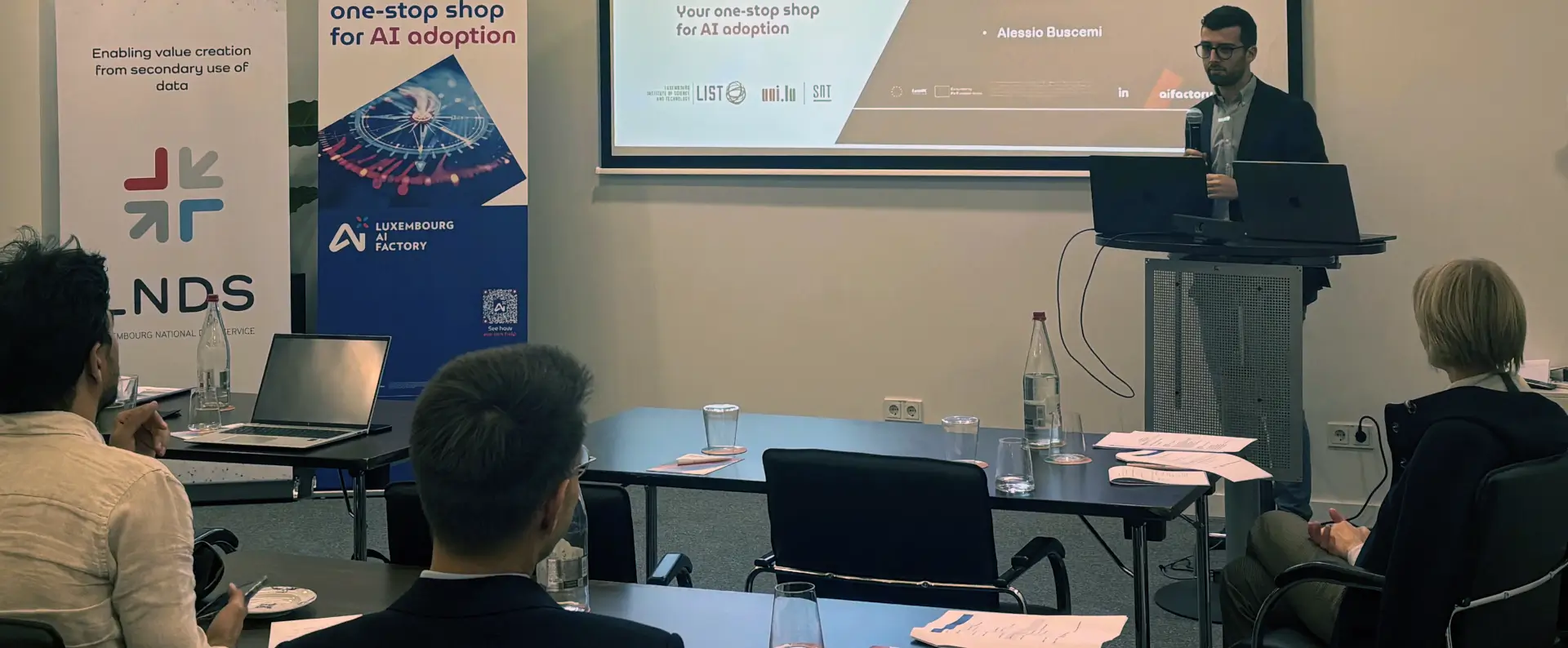
On 20 October 2026, Luxembourg AI Factory hosted the AI Act Lab: Designing implementation for AI systems at Meliã Luxembourg. The workshop brought together experts, practitioners, and stakeholders from research, industry, international institutions, and the European AI Factories network to explore how organisations can translate the requirements of the EU AI Act into practical governance, technical and organisational measures.
Organised by Massimo Fattori, Partnership Manager at Luxembourg National Data Service (LNDS), and moderated by Danijela Dimic, Senior Data Steward at LNDS, the event combined expert presentations with interactive group exercises, encouraging participants to share their experiences, discuss common challenges and explore approaches to trustworthy AI.
Representatives from AI Factories in Luxembourg, Austria, Italy, Finland and Spain participated in the workshop, highlighting the importance of cross-border knowledge sharing and collaboration in preparing Europe's AI ecosystem for regulatory requirements.
The AI Act presents shared challenges across Europe, but also an opportunity to learn from one another. By bringing together experts from different countries and sectors, we wanted to create a space for open exchange, where practical experiences can help us move from regulatory requirements towards implementation." - Massimo Fattori, Partnership Manager at LNDS.
Connecting policy, governance and practical AI implementation
The workshop featured contributions from experts representing European and international organisations, each addressing a different aspect of AI governance and regulatory readiness.
Dr. Emilia Tantar of the Luxembourg House of Cybersecurity opened the expert sessions with an overview of the relationship between standards and legislation, followed by an introduction to conformity assessment processes. Lucia Russo from the Organisation for Economic Co-operation and Development (OECD) introduced the Hiroshima AI Process Reporting Framework, highlighting international efforts to advance transparency and responsible AI governance.
Bringing an industry perspective, Daniel Stoica from Skillbourg discussed AI adoption in practice, focusing on emerging market needs and compliance challenges.
The afternoon programme explored further dimensions of trustworthy AI. Michael Löffler from AI Factory Austria examined data governance as a foundation for trustworthy AI, while Arnaud Ceol from Italy's IT4LIA AI Factory addressed the role of human oversight in ensuring accountability and effective control.
Alessio Buscemi from the Luxembourg Institute of Science and Technology (LIST) presented approaches to assessing AI systems through sandboxes. Andreas Braun and Elena Kazmina from PwC concluded the expert presentations by sharing market perspectives and lessons related to implementing AI governance and compliance measures.
Together, these contributions illustrated the range of considerations organisations must address, from data quality and risk identification to transparency, oversight and accountability.
From regulatory requirements to realistic AI use cases
A central feature of the AI Act Lab was its interactive format, which encouraged participants to apply the concepts discussed during the presentations to realistic AI scenarios.
The exploration of the case studies began during the first interactive session, which focused primarily on identifying potential risks and assessing how easily end users can understand the factors and reasoning behind a given AI-generated outcome. The guided questions also stimulated discussion among participants on the role of human oversight and the importance of the human-in-the-loop approach in AI-enabled systems.
During the second session, the analysis progressed to the examination of risk mitigation strategies and the identification of development phases where appropriate controls should be introduced. Another key topic was the availability of information provided to end users regarding the processes and decision-making mechanisms of AI systems. This led to a constructive discussion on how the AI Act contributes to transparency, accountability and traceability throughout the AI system lifecycle.
What made the workshop particularly valuable was the opportunity to work through realistic AI scenarios together. Participants brought different perspectives to the same challenges, showing how important it is to consider technical, organisational and human factors when implementing AI governance in practice." - Danijela Dimic, Senior Data Steward at LNDS.
Strengthening European AI collaboration
Beyond its technical and regulatory focus, the AI Act Lab provided an opportunity to strengthen connections between AI Factories and other organisations working towards the responsible development and adoption of AI. The participation of representatives from Luxembourg, Austria, Italy, Finland and Spain demonstrated the value of exchanging experiences across national networks.
To help businesses leverage these international synergies, Luxembourg AI Factory offers dedicated support through its Matchmaking - EU AI Factories service. This tailored service connects companies with other European AI Factories to accelerate innovation, share best practices and ensure successful AI adoption. By facilitating strategic partnerships across the European AI network, Luxembourg AI Factory provides a practical, guided pathway for small and medium-sized enterprises (SMEs) to collaborate on trustworthy AI initiatives and align with emerging regulatory standards.
Organisations preparing for AI Act compliance can explore the Luxembourg AI Factory service catalogue, which includes support for risk assessment, AI governance and cross-border collaboration.
