
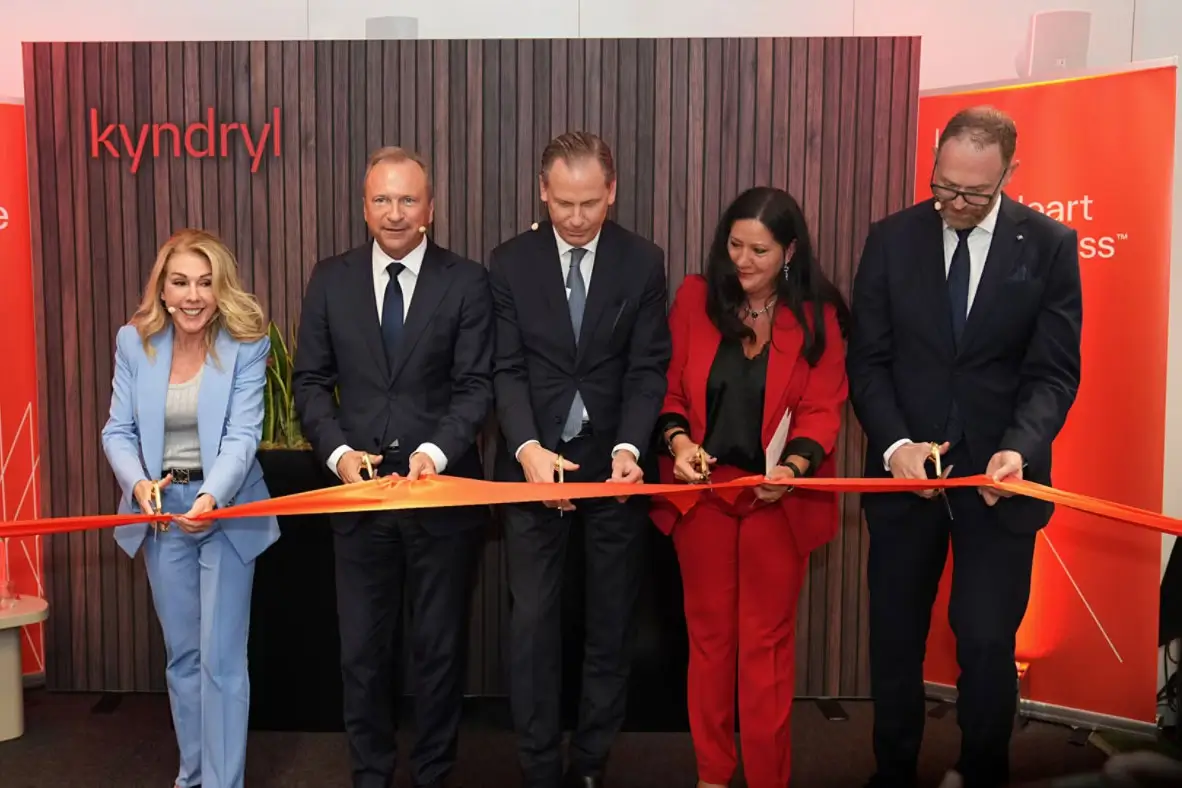
Kyndryl opens first EU AI innovation lab in Luxembourg
Kyndryl's first EU AI innovation lab opens in Luxembourg with BIL as founding customer, targeting agentic AI for regulated financial services.
21/10/2026
Kyndryl has announced the opening of its first European Union AI innovation lab in Luxembourg, specialising in agentic AI — AI systems capable of autonomous decision-making and multi-step task execution. The facility will scale to 250 highly skilled jobs by 2030, with Banque Internationale à Luxembourg (BIL) serving as its founding customer and collaborator.
Operating on a co-creation model, the lab enables companies to work alongside engineering experts to solve business challenges and rapidly prototype agentic AI workflows.
The partnership with BIL reflects a growing demand among financial institutions to co-create AI solutions that support innovation while maintaining data ownership and regulatory compliance. Mr Jeffrey Dentzer, Chief Executive Officer at BIL, highlighted the practical value of this collaborative approach.
The Kyndryl AI Innovation Lab […] will help us deliver simpler, more responsive services and better tools for our people, while maintaining the strong security, responsible governance and trusted human advice that define our relationship with clients. The recent transfer of BIL employees into Kyndryl further strengthens this partnership […], Jeffrey Dentzer, CEO at BIL
Compliance-first AI for regulated financial services
For organisations in regulated sectors, navigating compliance is as critical as technical performance. The lab will offer specialised expertise for regulated environments, helping clients address the risk-based requirements of the EU AI Act. Kyndryl has operated under the Commission de Surveillance du Secteur Financier (CSSF) Support PFS framework since 2004. Its designation as a Critical Third-Party Information and Communication Technology (ICT) Provider under the Digital Operational Resilience Act (DORA) further strengthens this compliance-first approach.
This focus on trust and structured implementation is crucial for turning AI experimentation into real business value. Ms Petra Goude , President of Strategic Markets at Kyndryl, explained the strategic choice of location.
Transforming AI ambition into measurable business outcomes requires more than technology. It requires collaboration, expertise and a clear path from innovation to implementation. Petra Goude, President of Strategic Markets qt Kyndryl.
Ms Goude also noted that Luxembourg sits at the perfect intersection of financial services, digital innovation and European regulation.
AI modernisation gap: what the data shows
The need for structured execution is underlined by Kyndryl's latest modernisation study. The report reveals that 37% of organisations in Europe rank AI adoption in their top three reasons to modernise. This is slightly higher than the global average of 34%. However, around half of European organisations are behind schedule on their modernisation initiatives. Additionally, 18% report receiving little value from these projects so far.
Unlocking capability with Luxembourg AI Factory
To help local businesses navigate these modernisation challenges and build robust AI capabilities, Luxembourg AI Factory provides tailored support services. As finance is one of the four key focus sectors of Luxembourg AI Factory—alongside space, cybersecurity and the green economy—the initiative is uniquely positioned to accelerate digital transformation in regulated environments.
Organisations looking to replicate this collaborative approach can leverage Luxembourg AI Factory services, such as Use Case Co-Creation to design their first AI pilot roadmap. Additionally, the AI Collaboration & Ecosystem Engagement service provides a direct pathway for companies to engage with the national financial technology ecosystem and explore real-world AI applications. These pathways enable businesses of all sizes to turn advanced technology into secure, compliant and operational reality.
Organisations can explore Luxembourg AI Factory services to identify their next step: from initial use-case definition to compliant, production-ready deployment.