
Can AI Code? The Debate Reshaping Software
At SCynergy 2026, a panel put the most consequential question in tech to five experts: what does AI for coding actually mean and where does it lead?
20/05/2026
In January and February 2026, SaaS companies collectively lost around two trillion dollars in market capitalisation. The reason, increasingly cited by analysts, is that more individuals and organisations are simply building their own applications using AI, bypassing off-the-shelf software entirely. The build-versus-buy equation, stable for decades, has lurched decisively in one direction.
The signals keep coming. Companies like Spotify and Shopify have said publicly, in their quarterly earnings calls, that their best developers are no longer writing code line by line — their role has shifted to guiding, prompting, overseeing. And Anthropic's latest coding model, Mythos, was deemed too dangerous to release after demonstrating capabilities for finding cybersecurity vulnerabilities and developing exploits that went well beyond its predecessor, itself released just weeks earlier. Rather than launch it, Anthropic announced a programme to help tech companies patch their software before the model ever goes public.
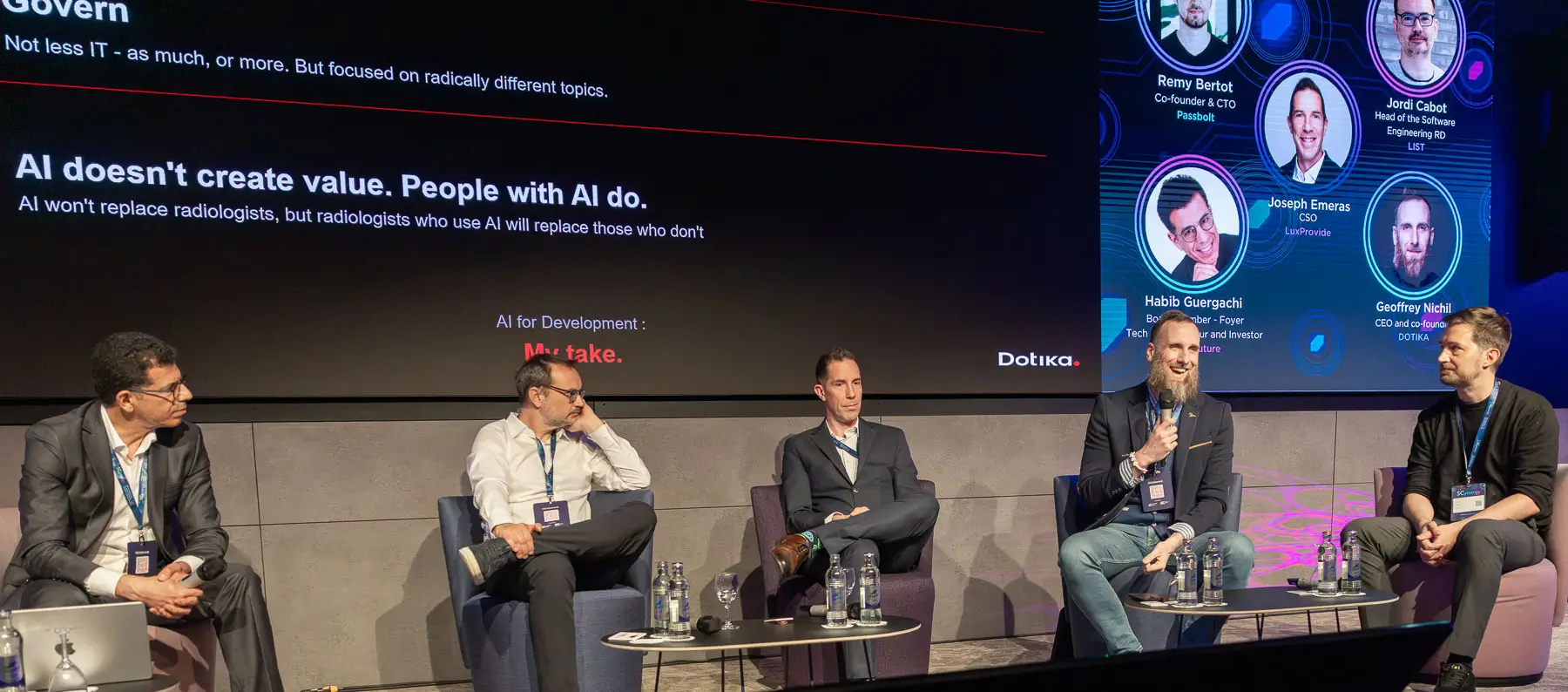
This is the landscape that framed the "AI for Coding" panel at SCynergy 2026 on April 15. Moderated by Dr. Idoia Landa Oregi, Scientist at the Luxembourg Institute of Science and Technology (LIST), the session brought together Remy Bertot, Habib Guergachi, Jordi Cabot, Geoffrey Nichil, and Joseph Emeras — five people with very different relationships to code and to what is happening to it.
Vibe coding, vibe modeling — and the gap between them
The term vibe coding has taken hold quickly: the practice of using AI assistants to generate software from natural language prompts, iterating in real time without deep technical knowledge. It's fast, it's accessible and it's increasingly powerful.
The first thing to emerge was consensus. Not on the solutions, but on the scale of the shift. AI is having a profound and accelerating impact on software development and the panel was unanimous that this is not hype to be waited out. The moment is real, the tools are working and the organisations treating this as a distant concern are already behind.
What remains genuinely contested is how to respond.
On one side: AI has already made it possible for people with no coding experience to build real applications, and that democratisation is an opportunity that individuals and companies should be seizing right now. Non-technical professionals can conceive software; AI can build it; the distance between business logic and technical implementation, long a source of friction, is collapsing.
On the other: feasibility is not the same as soundness. Capturing intent correctly — getting requirements right, testing rigorously, validating outputs — matters more in an AI-assisted world, not less. Code written by a machine still has to run in production, protect sensitive data and survive contact with real users. Data integrity, security, and IP protection don't simplify because the author was an algorithm. If anything, they become harder to reason about, precisely because the process is less visible.
The panel's sharpest framing came from the research side: vibe modeling as a counterweight to vibe coding. Where vibe coding emphasises speed — generate, iterate, ship — vibe modeling argues that AI's most durable contribution is helping teams think more clearly about what they are building before they build it. Design decisions made poorly at the start compound. Speed without structure doesn't disappear — it defers.
The harness question
After the first round, the moderator drew the threads together with an image that stuck: the need for a harness. Not a brake on AI adoption, but the infrastructure — technical, organisational and governance — that lets you ride the wave without being thrown by it. Guardrails. Oversight. The human judgment that sits above and around what the machine produces.
That reframing shaped the rest of the discussion.
For individuals, the question is about skills. As AI absorbs more of the routine mechanics of coding, what actually needs to be developed? The answer that emerged was less about learning to write code and more about learning to think like a system designer — understanding problems well enough to translate them into something a machine can execute and reading what comes back critically enough to know when it has gone wrong.
For organisations, the question is structural. What happens to software quality, sustainability and security when everyone can build an application? What does the IT function look like when citizen developers proliferate? Who is responsible for what gets deployed? These are not hypothetical concerns — they are live operational questions for any company that has started piloting AI-assisted development at scale.
For boards and leadership teams, the stakes are strategic. The possibility of reverse-engineering a business — rethinking software from scratch, now that non-technical people can conceive it and AI can build it — is genuinely exciting. It also comes with risks that require active preparation: around data, around IP, around the integrity of systems that the business depends on.
There is also an infrastructure dimension. For organisations that want to use AI for software development without exposing sensitive codebases or industrial secrets to external models, sovereign LLM inference — running models on controlled, Luxembourg-based infrastructure — is an increasingly viable path. The Luxembourg AI Factory, through its partner ecosystem, can offer exactly this kind of support to companies that lack the in-house expertise or infrastructure to do it themselves.
Three questions to take away
The panel produced a map of the decisions that individuals and organisations are facing right now:
- What are you actually trying to build? Speed to prototype is not the same as speed to production. The ambition has to be clear before the tools can serve it and AI is not a substitute for that clarity.
- Who owns the judgment? As AI takes on more of the mechanical work of coding, the premium shifts to people who understand systems deeply enough to evaluate what the machine produces, catch what it gets wrong and ask the right questions in the first place. That skill does not become less valuable. It becomes the thing that everything else depends on.
- Where does the risk actually sit? Governance is not a constraint on AI adoption — it is a precondition for it. The organisations that will benefit most from AI in software development are not the ones moving fastest. They are the ones moving with the clearest picture of what they are responsible for.
The hype around AI for coding is real. So is the work required to make good on it.
(This article was republished from LIST)