
Trust and strategy in Europe's AI startup ecosystem
Europe's AI startup ecosystem prioritises trust and collaboration over speed. Insights from SCynergy 2026 in Luxembourg.
21/05/2026
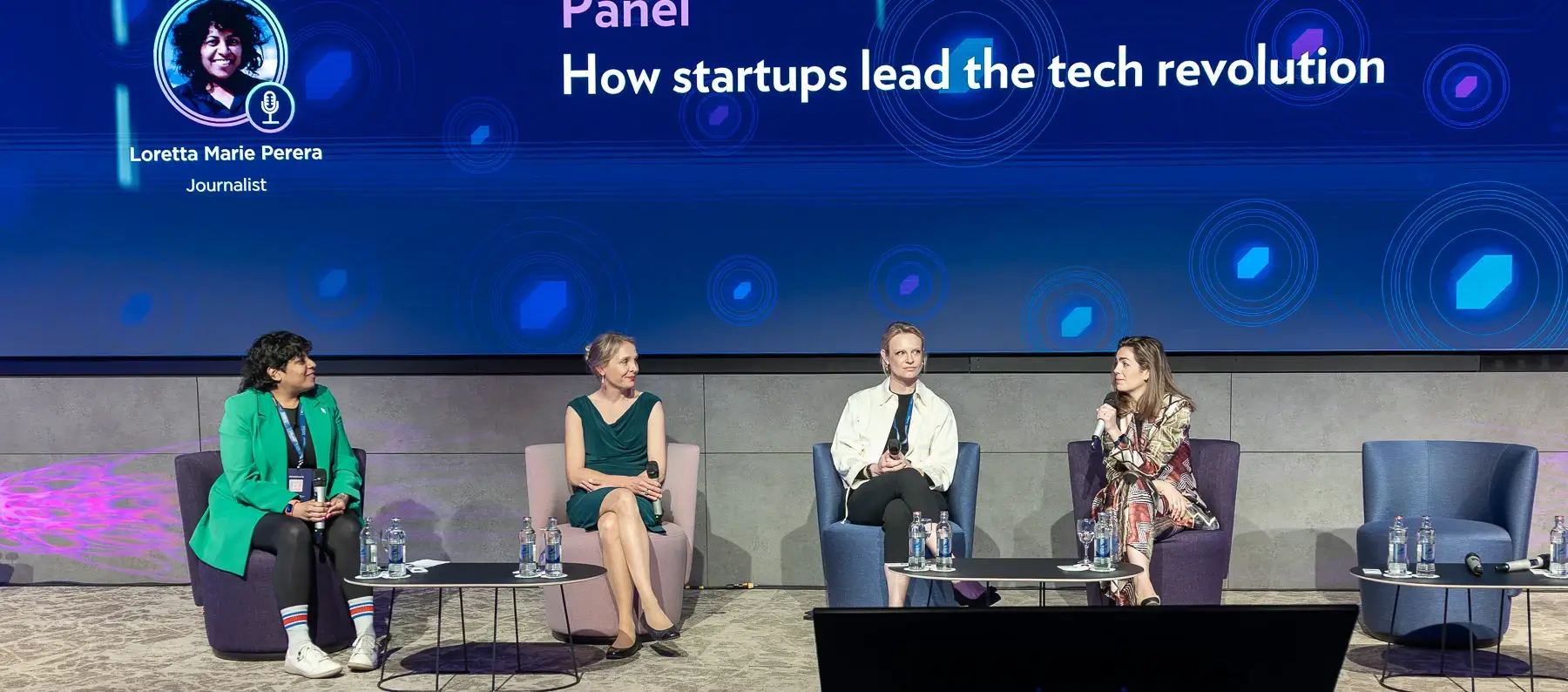
During a panel discussion on “How startups lead the tech revolution”, moderated by journalist Loretta Marie Perera at SCynergy 2026 held at the Luxembourg Chamber of Commerce, Crystal Van Oosterom, founder of Desai, Sara Robles Moreno, Head of Ecosystem of Tomorrow Street, and Genna Elvin, CEO of PULSE, shared their perspectives on how startups, corporates and policymakers can shape a competitive and trusted European AI startup ecosystem.
Why startups drive AI innovation in Europe
For Crystal Van Oosterom, startups are not just early builders of new technologies, they are forced to operate at the very edge of the unknown.
I like to think of startups as children: they cost a lot of money, they can’t earn their own way, they aren’t held accountable by the law in the same way, and they don’t know what they’re doing. And what that means is they are leading a revolution because they’re facing problems that nobody has faced before.”
Crystal Van Oosterom
This uncertainty, she argued, is precisely what makes startups strategically important for AI adoption in Europe. Long before regulation catches up, startups are already making decisions about ethics, responsibility and real-world deployment. These decisions shape markets and standards that others later follow.
Ms Van Oosterom also highlighted a reality sometimes overlooked in innovation discussions: “Those who determine who the winners are, are the clients.” For startups, strategic scaling is not about volume for its own sake, it is about solving concrete problems in a way that delivers lasting value. This aligns closely with a European approach that favours precision, responsibility and long-term impact over short-term acceleration.
Agility remains one of the strongest assets startups bring to AI innovation. Smaller teams can move quickly, test ideas faster and adapt to changing conditions in ways that large organisations often struggle to match. In the rapidly evolving AI landscape, this speed of learning, rather than sheer size, becomes a decisive advantage.
How trust sets Europe's AI ecosystem apart
Genna Elvin described a clear shift in how AI is perceived and used. Once seen as something exceptional, AI is now becoming part of the everyday environment. “The way in which we’re interacting with AI is making it normal, it’s becoming part of the mundane.” As AI integrates into standard workflows and processes, the focus moves away from novelty towards execution.
This change has significant implications for both startups and corporates in Europe. Value is no longer measured by how much code is written but by how well technology is orchestrated, integrated and translated into real outcomes. Ms Elvin stressed that Europe does not need to compete on speed or scale with other regions, a point she summarised simply:
We should try and focus on what we have been doing well for a long time. It’s trust.”
Genna Elvin
For Europe, and for the European AI startup ecosystem in particular, trust is not a limitation, it is a strategic asset. By prioritising reliable systems, transparent data use and responsible innovation, Europe can position itself as a trusted destination for trade and technology collaboration.
Trust also plays a role in talent attraction. Ms Elvin emphasised that the profiles Europe wants to attract are motivated by meaningful challenges. High-level technical problems, complex deployments and real responsibility can be stronger incentives than speed alone. Creating environments where talent can work on difficult, high-impact problems is essential to sustaining Europe’s AI capabilities.
Corporate-startup collaboration: the key to scaling AI in Europe
Sara Robles Moreno framed startup and corporate collaboration as a simple reality rather than a strategic debate. “Corporates need startups and startups need corporates.” In her view, the European AI startup ecosystem functions only when this mutual dependency is recognised and actively supported.
Corporates face structural challenges, ranging from legacy systems to complex governance. For startups, these challenges represent opportunities. If a startup can solve a real corporate problem, that solution becomes its lifeblood. At the same time, startups rely on corporates for access to industry knowledge, operational experience and highly skilled engineers.
Corporates require the innovation that comes from smaller companies that are rethinking and reinventing themselves. And startups need corporates to feed them knowledge and best-of-industry practices and best-of-class engineers.”
Sara Robles Moreno
Ms Robles Moreno also pointed to Europe’s distinct ecosystem approach, where public support, corporate engagement and startup ambition intersect. Rather than scaling for volume, Europe has the opportunity to scale for strategy, ensuring that AI solutions are sustainable, sovereign where needed, and aligned with long-term economic goals.
Looking ahead, she expressed optimism about what lies ahead. “I think the future is extremely bright. This technology is enabling and used in the right way it will be a game changer for everyone.” For Europe and Luxembourg, the challenge is to channel that potential through ecosystems that value cooperation, responsibility and trust.
The SCynergy panel made one point clear: the future of the European AI startup ecosystem will not be defined by who moves fastest, but by who builds wisely. By combining startup agility, corporate strength and a long-standing commitment to trust, Europe can shape a distinct and competitive path for AI innovation, with Luxembourg and the Luxembourg AI Factory playing a key role as a connector and convener in this evolving landscape.