
Space-based quantum communication takes shape in Luxembourg
HITEC Luxembourg is building a space-to-ground quantum key distribution link to extend Europe's secure communications network from Luxembourg.
 Emilio Naud
09/11/2026
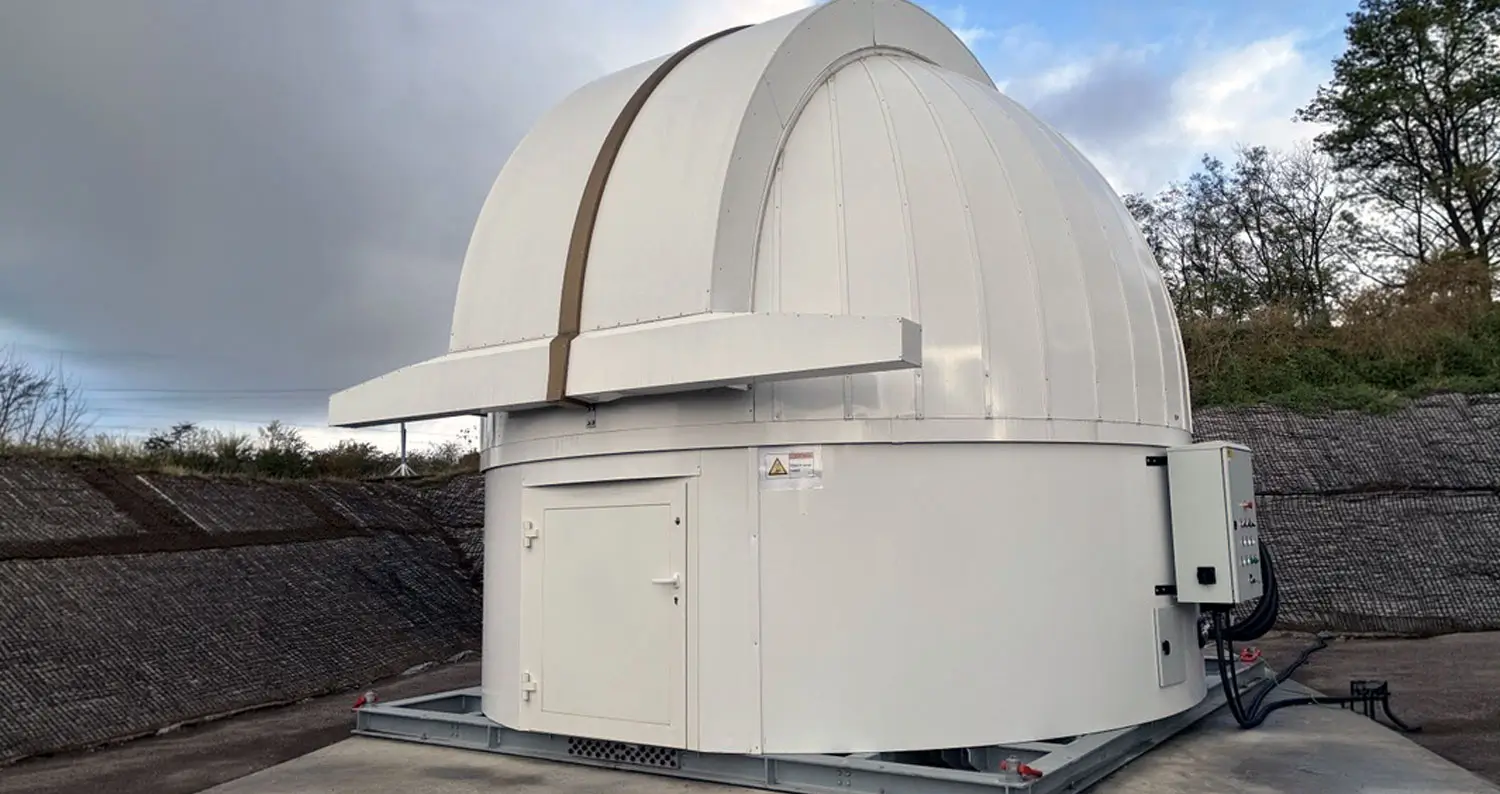
Catching single photons beamed from a satellite orbiting hundreds of kilometres above is no longer science fiction. On a small field in Luxembourg, Mathieu Esteve, Manager of the Ground Segment Division at HITEC Luxembourg, is leading the project and engineering team making it a commercial reality. This upcoming milestone will demonstrate the feasibility of space-based quantum key distribution (QKD) to secure communications globally.
From fibre optics to satellite: extending quantum networks
In Luxembourg, pioneering efforts like the INT-UQKD (International Use Cases for Operational Quantum Key Distribution Applications and Services) project signal a strong commitment to building quantum-safe infrastructure. Led by Starion Luxembourg, the consortium includes POST Luxembourg, the University of Luxembourg's Interdisciplinary Centre for Security, Reliability and Trust (SnT) and HITEC Luxembourg. While the terrestrial network already connects Luxembourg and Belgium, physical limitations restrict these fibre-optic links to approximately 100 to 150 kilometres before the quantum signal degrades.
"The purpose of the space link is to extend the QKD network," Mr Esteve noted, explaining that terrestrial intermediate nodes are expensive to install, constitute a security threat and are difficult to maintain over long distances. To bridge continents, space-based links are essential. Under the INT-UQKD project, quantum keys will be distributed from a satellite operated by the Singapore-based company SpeQtral. HITEC's optical ground station (OGS) will act as the critical receiver on the ground in Luxembourg to ensure the connection between Singapore and Belgium."
BELUCA 080: an industrial optical ground station
To address this need, HITEC collaborated with Belgian optics specialist AMOS to develop BELUCA 080, an industrialised optical ground station designed to catch photons beamed down from satellites. This product combines HITEC's expertise in constructing complete, remotely controlled ground stations with AMOS's precision optics. "So far you have RF antennas, you have telescopes for classical astronomy or optical communication, but none were responding to the demand for the QKD application" Mr Esteve explained.
He also pointed out that standard optical systems often disrupt the delicate quantum properties of the photons. Inside the satellite, entangled photons -pairs of photons whose quantum states are linked- are generated, and BELUCA 080 must intercept them without altering their spin or polarisation (a parameter tracked as the polarisation extinction ratio). "The purpose of the OGS is to be able to catch the particles without affecting the spin or the polarization of the quantum key" Mr Esteve said.
Securing finance and defence with quantum keys
According to Luxinnovation's Quantum Market Applications report, the European quantum communication market was valued at roughly €314 million in 2024 and is projected to reach approximately €1.5 billion by 2030, growing at a compound annual growth rate of 31.3%. This rapid acceleration is driven by operational needs for ultra-secure data transmission in highly regulated sectors. The report highlights banking, finance and insurance, alongside defence and government, as high-opportunity areas.
"The primary interest is coming from the finance sector and governmental institutions," Mr Esteve agreed, noting that these sectors handle the most sensitive data. The operational viability of QKD has already been demonstrated in major trials. For example, HSBC successfully trialled QKD to secure a €30 million trading scenario involving the exchange of euros for US dollars. In the defence sector, Altice Labs demonstrated a quantum-secure military network as part of the DISCRETION project, proving the readiness of QKD for high-security government applications.
The strategic importance of this technology is underscored by the looming threat of quantum computing, which could crack widely used classical encryption algorithms. "The purpose is to provide an answer to that threat by using the physical properties of particles," Mr Esteve explained. Given that quantum key distribution relies on the quantum state of the photon, any eavesdropping attempt is immediately detectable, because measuring the system inevitably alters its state. Any intercepted keys can thus be discarded.
A European network for resilient quantum links
The BELUCA 080 was designed from the outset as an industrial product rather than a one-off demonstrator. "We have conceived the BELUCA 080 as a product, not as a one shot, and it was designed from the beginning to be an industrial and cost-effective solution," Mr Esteve emphasised. The company is also participating in the Trans-EuroOGS in the frame of the EUROQCI programme with Germany, Ireland and Greece. The programme will deploy eight optical ground stations to test how a distributed network can compensate for local weather disruptions such as cloud cover, rain and wind.
Looking to bring quantum-enabled or advanced communication technologies to market? Our European programmes advisory can help you identify and secure relevant funding, including Horizon Europe calls related to quantum and cybersecurity.
To discover more about the underlying technology, explore our report on quantum communication.
