

AI adoption in Luxembourg: 59% rate and new challenges
A new AI study shows 59% of Luxembourg organisations use generative AI. Cost of ownership, governance and skills gaps are the key barriers to scale.
 Emilio Naud
02/06/2026
Luxembourg AI Factory, Luxinnovation and the FEDIL just published their 2026 "Perspectives on AI and Generative AI in Industry" study. The survey shows that 59% of organisations in Luxembourg are already using generative AI (GenAI). This rapid adoption marks a shift in maturity: the primary challenge is no longer a lack of skills but the total cost of ownership (TCO) — the full financial cost of industrialising AI projects, including data preparation, infrastructure, cybersecurity, governance and maintenance.
From pilot to production: cost of ownership becomes the main barrier to AI deployment
The era of AI experimentation in Luxembourg is over. As shown in the graph below, while the technical skills shortage was the main obstacle in 2025, today it is the total cost of ownership that has become the number one barrier to large-scale deployment. Companies, having moved on to pragmatic, high-impact applications, are now facing the financial reality of industrialisation: data preparation, infrastructure, cybersecurity, governance and maintenance. This shift marks a new phase of maturity: the question is no longer "why" use AI, but "how" to deploy it in a profitable and secure manner.
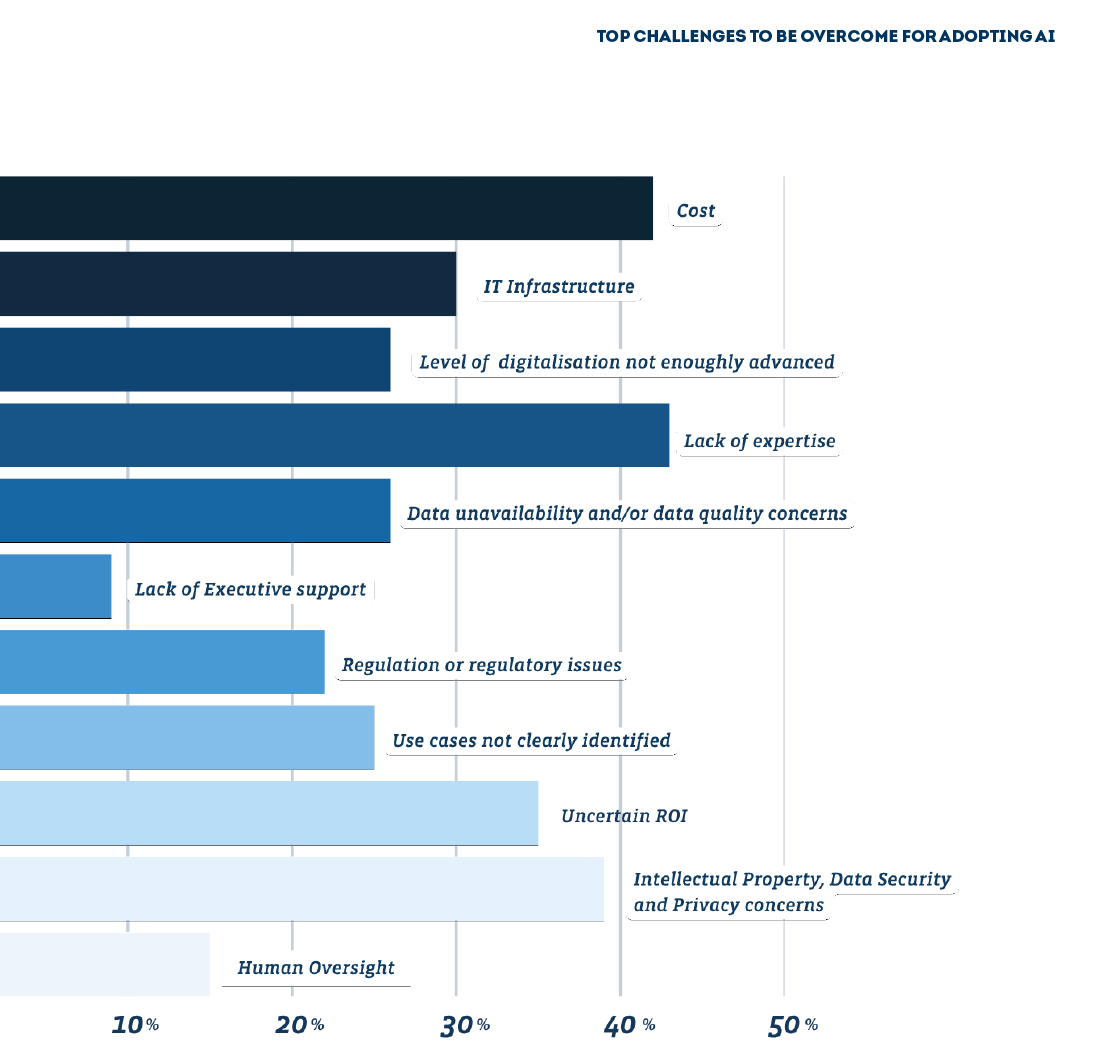 Top challenges to be overcome for adopting AI
Faced with this return on investment challenge, de-risking projects upstream has become crucial. To achieve this, This is precisely the mission of services like the Luxembourg AI Factory's "Roadmap definition", which helps companies assess the technical feasibility and relevance of a use case before investing. For SMEs ready to take the leap, the "Fit 4 AI" programme offers a framework and co-funding to structure a clear roadmap, turning an ambition into a profitable business project. Luxembourg AI Factory also guides companies towards national and European funding mechanisms.
AI governance and data quality: the challenges of scaling up
The widespread adoption of AI, particularly generative AI (used by 59% of organisations), has placed governance and data quality at the centre of business concerns.
The study reveals a significant gap between data collection and its strategic use:
- 79% of companies collect customer data
- 35% systematically assess its quality
- 23% systematically analyse it for decision-making
This disparity between the volume of data available and its actual usability is a major obstacle to value creation.
Furthermore, just 48% of respondents have an AI governance policy in place, highlighting the urgent need to structure its use.
This awareness is reinforced by the European AI Act, cited by 44% of companies as a motivation to act, an increase of 14 points from 2025 (when the figure was 30%). In this context, the trend towards sovereignty is confirmed: 53% of companies plan to host their GenAI solutions locally. To navigate this complexity, the Luxembourg AI Factory offers support in "Data Quality and Curation" to turn raw data into exploitable assets and its "AI Assessment Sandbox" provides a unique testing environment to ensure solutions comply with future regulatory requirements.
AI and productivity: a high potential still held back by the skills gap
The expectations of companies are clear: 88% associate AI with gains in productivity and efficiency. However, this optimism clashes with persistent obstacles. While the talent shortage is less cited as the main barrier, the study reveals a critical lack of specific skills in machine learning and data analysis. The paradox is that while 38% of companies cite a lack of skills as a barrier, almost half of them state they do not know where to find suitable training to address it.
This mismatch between strategic ambition and operational capability is holding back the full exploitation of AI's potential. To bridge this gap, Luxembourg AI Factory, through its ecosystem of partners, provides access to a training catalogue and upskilling initiatives. The goal is to enable companies, from SMEs to large corporations, to train their teams and attract the talent needed to turn their productivity potential into concrete results.