
Securing AI: cybersecurity in the AI era
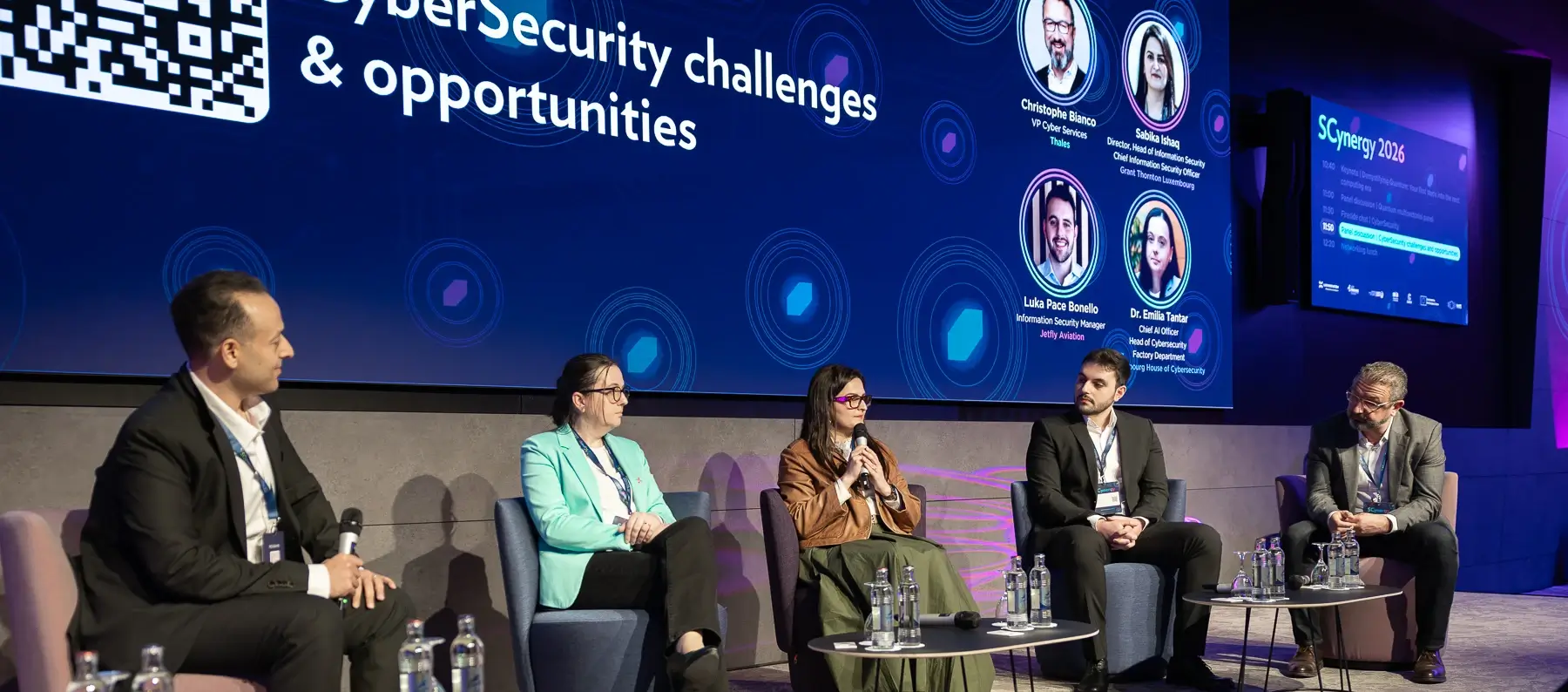
As AI reshapes cyber risks, experts at SCynergy 2026 explored how Europe can strengthen security, trust and digital autonomy.
28/05/2026
As artificial intelligence (AI) accelerates innovation, it is transforming both cyber threats and defence strategies. At SCynergy 2026, experts from Luxembourg’s ecosystem examined how organisations can adapt to increasingly complex risks while maintaining trust in digital systems.
How AI is transforming cyber threats
With cybercrime projected to reach $10 trillion annually, AI cybersecurity is becoming one of the most significant economic challenges. This calls for a shift in mindset. As Luka Pace Bonello, Information Security Manager at Jetfly Aviation, noted, cybersecurity must “become an extension of existing operations” and fully integrated into day-to-day processes.
From system protection to decision integrity
In the financial sector, Sabika Ishaq, Director and CISO at Grant Thornton Luxembourg, highlighted how AI is increasing the scale and sophistication of cyberattacks. Criminals are now able to operate with “precision and personalisation at scale”, enabling highly targeted fraud and phishing campaigns.
This evolution has direct implications for organisations handling sensitive data and transactions. As Ms Ishaq explained, the role of AI cybersecurity is expanding: “We are not just defending the systems. We are actually defending the decision-making processes that are powered by AI today.”
When cyber risk becomes a safety issue
In aviation, the stakes extend beyond data security. Luka Pace Bonello explained how cyber incidents can quickly evolve into safety risks when they affect operational decisions.
Manipulating data such as weather information or maintenance records may not cause immediate disruption, but it introduces uncertainty into systems that rely on precision. “You have introduced a bit of uncertainty in a system that requires reliability,” he said, highlighting how small deviations can accumulate across operations.
You should make sure that you are controlling AI and that it is not controlling you; keep your hands on the wheel.”
Luka Pace Bonello, Jetfly Aviation
Reducing dependency and strengthening autonomy
Panellists also raised concerns about Europe’s reliance on a limited number of technology providers. Christophe Bianco, VP Cyber Services at Thales, warned that the region risks falling behind in a rapidly evolving global landscape.
“When we look at the dynamics of what is happening, my main concern is that we are not as fast as we should be,” he said, pointing to the gap between technological developments and Europe’s response.
For organisations, this raises important questions about AI cyber resilience and strategic positioning, particularly in critical sectors.
In Luxembourg, these challenges are being addressed through initiatives linked to the national AI strategy. Emilia Tantar, Chief AI Officer at the Luxembourg House of Cybersecurity, emphasised the importance of building internal capabilities and reducing reliance on external tools: “You need to build your strategic autonomy, the autonomy of your skills.”
She also highlighted the risks of over-reliance on seemingly free technologies, cautioning against a “free lunch” approach to AI tools that may come with hidden dependencies.
Building skills and strategic trust
The discussion concluded that technology alone is not enough. Skills, education and human oversight remain essential to ensure that AI systems are used responsibly and securely.
As Christophe Bianco noted, organisations need to invest more in expertise to “go deeper on the problems” and keep pace with rapid technological change.
Ultimately, AI cybersecurity is evolving beyond a technical discipline. It has become a matter of strategic trust, requiring organisations to ensure confidence in their systems, data and decisions.
To support organisations on this journey, the Luxembourg AI Factory offers services and opportunities to develop trusted AI solutions and strengthen cybersecurity capabilities.