
Luxembourg advances AI literacy with Elements of AI programme
Over 7,600 people completed the Elements of AI programme in Luxembourg. Experts discuss AI's impact on jobs, upskilling needs and business innovation.
 Emilio Naud
03/06/2026
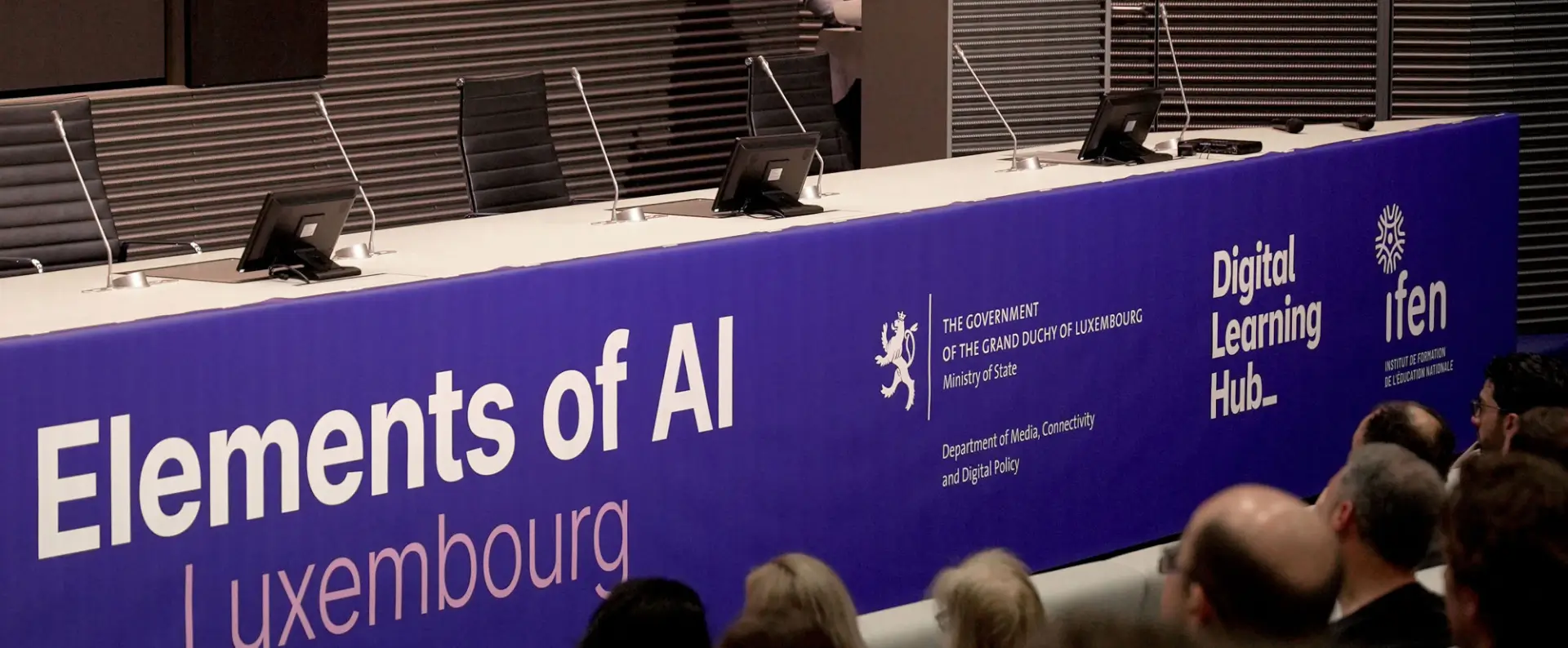
Luxembourg has reached a key milestone in AI literacy: over 7,600 people have completed the Elements of AI programme (a free online course about AI literacy created by MinnaLearn and the University of Helsinki), exceeding the government's target of 1% of the working-age population. At a closing conference held on 20 May 2026 at the Digital Learning Hub, 250 attendees including policymakers, labour market experts and educators discussed the impact of AI on jobs, the growing importance of human skills, and the role of targeted programmes like the Luxembourg AI Factory in helping businesses adopt AI responsibly.
Over 7,600 participants: Luxembourg meets its AI literacy target
Elisabeth Margue, Minister Delegate to the Prime Minister for Media and Connectivity, announced that over 7,600 people have participated in the programme since its launch in 2021, achieving the government’s goal of reaching 1% of the working-age population by 2030. She emphasised Luxembourg's "people-first approach" to AI, stating, "We want AI to be human-centred, transparent and accessible." The Minister also highlighted the importance of clear governance, noting that Luxembourg is actively preparing for the implementation of the European AI Act to ensure "trust, legal certainty and responsible innovation."
How AI is reshaping jobs in Luxembourg
Isabelle Schlesser, Director of ADEM, provided a detailed analysis of AI's impact on the workforce. Citing a study by STATEC, she explained that 55% of jobs in Luxembourg will be complemented by AI. However, about “14% are at risk of being so transformed that they would nearly disappear.” This affects an estimated 65,000 people in Luxembourg, particularly in administrative and back-office roles. She also pointed to significant opportunities for AI augmentation in sectors like finance and health. Serge Linckels, Managing Director of the Digital Learning Hub, added context by tracing AI's evolution from simple rule-based systems to today’s "agentic AI," systems that can plan, reason and execute complex tasks with minimal human oversight.
Why soft skills matter in an AI-driven workplace
In this new landscape, technical knowledge alone is not enough. Schlesser stressed that uniquely human abilities are becoming more critical than ever. "Communication skills, creativity, problem-solving, all these soft skills will in my opinion remain and perhaps become more important in the future," she advised. This sentiment was echoed in the practical training offered by the Digital Learning Hub, which Linckels noted includes specialised programmes like the AI Academy and cybersecurity training, designed to build both technical and soft skills for the jobs of tomorrow.
Luxembourg AI Factory: from AI knowledge to business adoption
For businesses looking to translate foundational AI knowledge into a real competitive advantage, the journey continues beyond general education. This is where the Luxembourg AI Factory provides the crucial next step, offering dedicated programmes that guide companies in their AI adoption journey. It supports small and medium-sized enterprises (SMEs) in moving from an initial idea to a developed proof-of-concept and ultimately to a market-ready AI solution. By offering access to expertise, testing environments, and support, we ensure local businesses have the resources needed to innovate successfully.
By combining public upskilling with targeted support for business innovation, Luxembourg is, as Schlesser concluded, "well-positioned to become one of the champions in Europe" in the responsible and effective adoption of AI.
Key figures from the Elements of AI closing conference
- 7,600+ participants in the Elements of AI programme
- 1% of Luxembourg's working-age population reached (government target met)
- 55% of jobs will be complemented by AI (STATEC study)
- 14% of jobs at risk of near-disappearance due to AI transformation
- 65,000 workers potentially affected, primarily in administrative roles